
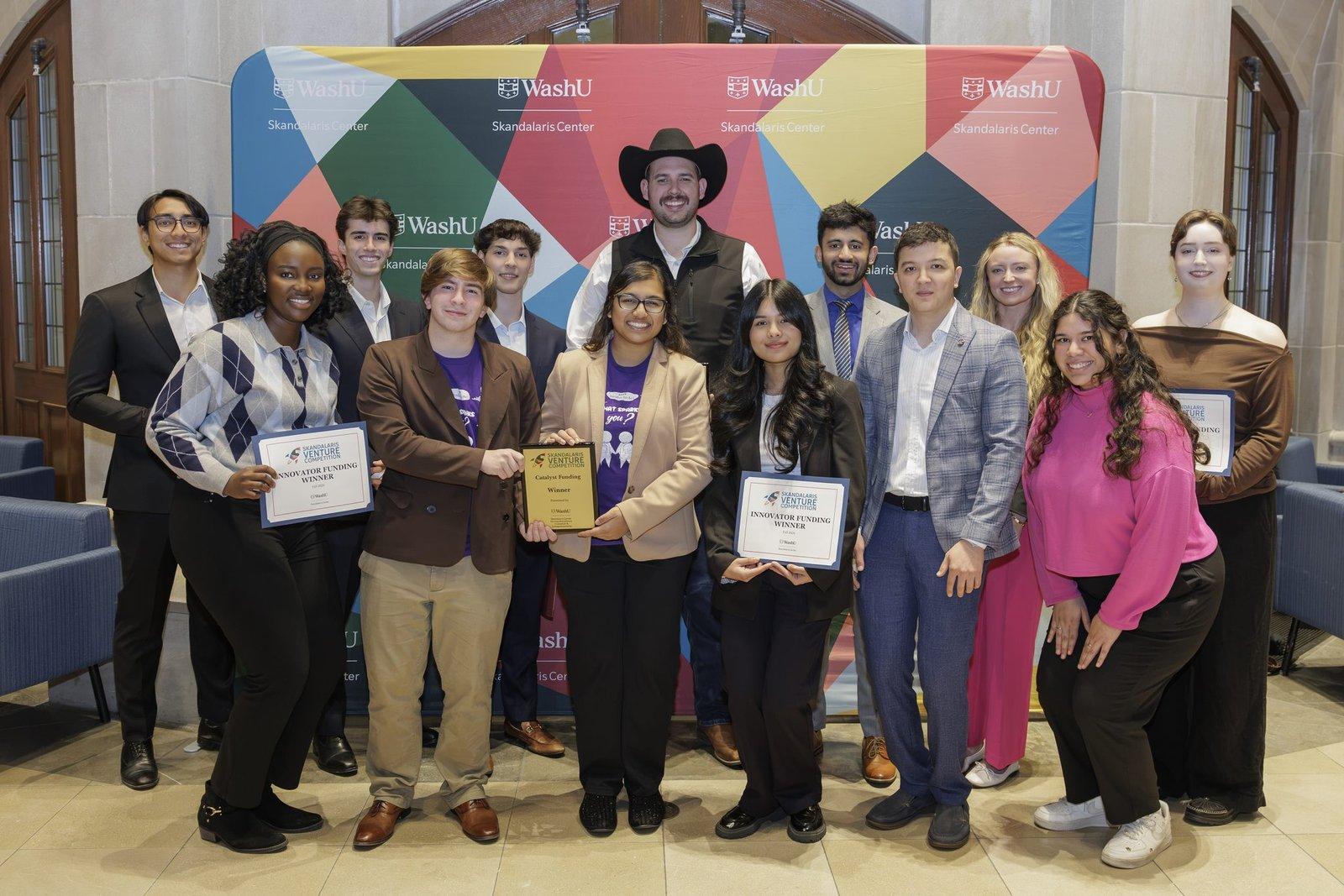
ParamAI, the startup founded by our chief medical officer, Anish (Max) Bagga, won $5,000 in Disruptor Funding at the Fall 2026 Skandalaris Venture Competition. The winners were announced on November 18, the evening of the finals, at the WashU Innovation & Entrepreneurship Awards. Read it at the Skandalaris Center
- semifinalists in the fall competition
- 32
- semifinalists in the fall competition
- finalists who pitched on November 18
- 16
- finalists who pitched on November 18
- startups funded, ParamAI among them
- 8
- startups funded, ParamAI among them
What this means for Sling Health teams
The same money is open to every Sling Health team, and to any member building a startup of their own. The competition runs again in the spring. More than half of this fall's teams were entering for the first time, so a team does not need to be far along to compete. Start your deck now and watch the Skandalaris Center for spring dates.
You can also apply now for the Holekamp Seed Fund, which gives $1,000 for early startup costs to WashU juniors, seniors, and graduate students who own at least 40% of a startup. Applications are rolling through April 15. Read our story on the fund or apply on the fund's site.
The competition
The Skandalaris Venture Competition is WashU's university-wide startup competition. It gives student founders mentorship and non-dilutive funding, money that costs them no equity. This fall, entries came from seven WashU schools.
In October, the Skandalaris Center named 32 ventures semifinalists. They kept doing customer discovery and gave two-minute pitches to judges on October 21, and 16 advanced to the finals. On November 18, the finalists pitched a panel of judges at the Danforth University Center, and the winners were announced that evening at the awards in Crowder Courtyard. In all, $41,000 went to eight startups, in three tiers. Catalyst Funding, up to $10,000, backs startups ready to grow. Disruptor Funding, $5,000, backs startups refining a product on the way to market. Innovator Funding, $2,000, backs early ideas still being tested. ParamAI was one of two Disruptor winners.
The problem: finding the dose
Finding the right dose of a cancer drug can take 15 years. Lab and animal studies take about two and a half, human trials about six and a half, and FDA review about one. Even after approval, 59% of new cancer drugs needed more dose studies, a median of five more years. Developing one cancer drug costs an estimated $648 million, and the dose can still be wrong. Most of the patients waiting do not have 15 years.
A dose rests on a few numbers, chief among them how fast the body clears the drug and how much of it reaches the blood. Those are hard to measure in people before a drug has been given to people, so developers estimate them from animal studies and chemistry, and the textbook methods are often far off.
What ParamAI builds
ParamAI is a machine learning platform that predicts those numbers from the evidence a development team already has, its chemical structure, lab assays, and animal studies, and gives a range for each prediction instead of a single guess. It sharpens the prediction with every new result and suggests which lab or animal study to run next.
ParamAI has tested its prototype on published data from real drugs.
- real drugs tested, beating all six standard methods for clearance and volume
- 371
- real drugs tested, beating all six standard methods for clearance and volume
- of predictions within 2-fold of the true value, against 51% for the best standard method
- 58%
- of predictions within 2-fold of the true value, against 51% for the best standard method
- FDA-labeled drugs whose measured peak blood level fell inside ParamAI's range
- 25 of 27
- FDA-labeled drugs whose measured peak blood level fell inside ParamAI's range
The ranges are also about half as wide as those of any standard method. One case ParamAI tested is Gleevec, the drug that turned a deadly leukemia into a manageable disease. Held out of training, its true human clearance is 3.3 mL/min/kg. ParamAI predicted 6.8. Scaling from dog data alone gave 24, and the textbook rat and dog method gave 56, 17 times too high.
The first customers ParamAI is after are preclinical biotechs making small-molecule cancer drugs, which today pay consultants to build these models. The timing helps. The FDA's Project Optimus asks companies to find the best cancer drug dose in early trials, the FDA plans to make animal studies the exception, and a 2026 international guideline lets mathematical models support dose decisions when they show their uncertainty.
How it got here
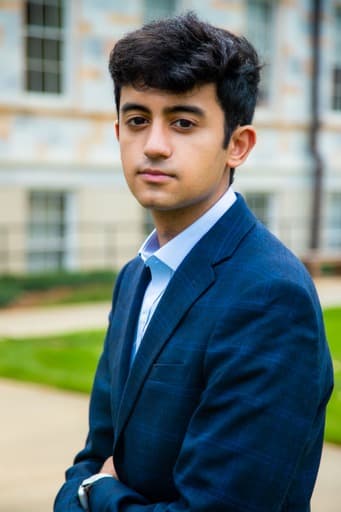
Max founded ParamAI as a second-year medical student at WashU Medicine. His research builds mathematical models of human physiology and disease, and the software he helped deploy has been used in millions of clinical decisions. The company has been through more than 60 interviews with people at drug companies, investors, and universities to find its customer.
- May 2026: MD+ Fellowship
- October 2026: Nucleate Activator semifinalist
- November 2026: beat the standard methods on 371 real drugs, and won Disruptor Funding at the Skandalaris Venture Competition
What comes next
The plan is to present at the American Society for Clinical Pharmacology and Therapeutics in March 2027, publish a final test in August, and run pilots with two biotechs by September 2027. ParamAI is hiring a machine learning engineer, a pharmacometrician, a regulatory affairs lead, and a commercial lead. If that is you, see ParamAI on our teams page or visit its site.
If you want to build something like it, get involved or send us a problem.